The OMER flash crash on June 12, 2026 is a textbook example of how fast a volatile stock can collapse. On June 12, 2026, shares of Omeros Corporation (OMER) did something that strikes fear into every investor who’s ever held a volatile stock: they fell off a cliff. Within the first 15 minutes of trading, the stock collapsed from $10.01 to a low of $6.70 — a drop of more than 33% from the open in a matter of minutes. By the closing bell it had clawed back to $8.74, but the damage was done, and the lesson was written in red candles.
This is what a flash crash looks like. And understanding how and why they happen is one of the most important things a self-directed investor can learn.
What Actually Happened
We ran the full breakdown through Ask The Desk. Here’s the picture:
OMER opened at $10.05, briefly touched $10.11, then collapsed to an intraday low of $6.70 before recovering to close around $8.74 — a session loss of roughly 14.2%. But the headline percentage doesn’t capture the violence of the move. The bulk of the damage happened in the very first 15-minute candle, where the stock plunged from $10.01 straight down to $6.71.
The tell was in the volume. Roughly 7.78 million shares changed hands — about 4 to 7 times the stock’s typical daily volume of 1 to 2 million. That kind of volume spike is a classic signature of a major, news-driven event.

OMER Flash Crash 15-min chart, June 12 2026 — the opening crash from $10 to $6.70. Source: In2Trading.
Why Stop-Loss Orders Still Matter — Even When They’re Not Perfect
It’s tempting to look at a chart like OMER’s and conclude that stops are useless. If a stock can fall $3 in fifteen minutes, what good is a stop order that fills somewhere on the way down? But that’s the wrong lesson. In a move like this, a stop loss is often the single thing standing between a manageable loss and a catastrophic one.
Here’s the core idea: a stop loss isn’t designed to get you the perfect price. It’s designed to get you out. In a fast, cascading decline, the worst position to be in is frozen — watching the number fall, telling yourself it’ll bounce, hoping instead of acting. A stop removes that decision from your hands at exactly the moment your judgment is least reliable: when you’re panicking. It executes automatically, without emotion, while you’re still processing what’s happening.
Consider OMER’s path: open at $10.01, low of $6.70, recovery to $8.74. An investor with a stop somewhere in the $9 range would have been taken out of the position relatively early in the collapse. Yes, they’d have taken a loss — but they’d have avoided riding the full plunge to $6.70 and the gut-wrenching decision of whether to sell at the bottom or hold. A stop converts an open-ended, emotional situation into a closed, defined one. That alone is worth a great deal.
Understanding Slippage: When Your Fill Doesn’t Match Your Stop
This is where most investors get confused — and where the OMER scenario teaches a critical lesson.
When you set a stop-market order, you’re telling your broker: “If the price hits X, sell my shares at the next available price.” The important phrase is next available price — not X. The moment your stop triggers, it becomes a market order, and it fills at whatever buyers are willing to pay at that instant.
In a calm market, that’s fine. If your stop is $9.43 and there are plenty of buyers around $9.40, you’ll fill within a few cents. That small gap between your stop price and your actual fill price is called slippage. A few cents of slippage on a normal day is completely standard execution — nothing went wrong.
But in a flash crash, slippage can get ugly. When OMER dropped from $10.01 to $6.71 in the opening candle, the buyers vanished. If your stop triggered at $9.50 during that plunge, there might not have been anyone bidding $9.50 — the next available buyer could have been at $8.50, or $7.50. Your order would fill there, well below your stop. That’s not a malfunction. That’s the market simply not having buyers at your price during the panic.
This is the trade-off every investor needs to understand:
- A stop-market order guarantees you’ll get out, but not at what price. In fast markets, you can slip badly.
- A stop-limit order guarantees your price, but not the exit. If the stock blows past your limit, the order sits unfilled — and you’re still holding as it falls.
Neither is “better.” They protect against different fears. In a flash crash, a stop-market order will get you out (with slippage), while a stop-limit order might leave you trapped in the position with no fill at all. For most investors holding volatile names, getting out — even at an imperfect price — is the priority.
The Honest Bottom Line on Stops
A stop loss is not a force field. It won’t save you from a gap-down on a failed drug trial, and it won’t guarantee a clean exit in a flash crash. What it will do is enforce discipline when you need it most, cap an open-ended loss before it becomes a portfolio-altering one, and take the decision out of your shaking hands at the worst possible moment.
The investors who get hurt the most aren’t usually the ones whose stops slipped a little. They’re the ones who had no stop at all — who watched OMER fall from $10 to $6.70 with no plan, no exit, and no rule to follow except hope. A stop that fills imperfectly still beats no stop at all, every single time.
The Technical Damage
By the time the dust settled, the chart was wrecked across the board:
- RSI at 24.21 — deeply oversold, well below the 30 threshold
- Price below every key moving average — the 20-SMA ($10.84), 50-SMA ($12.33), and 200-SMA ($9.99) all sat above the stock
- Bollinger Band %B at -5.1 — an extreme reading showing price had blown far below the lower band
- MACD negative and widening — confirming the bearish momentum was accelerating, not fading
- On-Balance Volume falling — selling pressure had been building
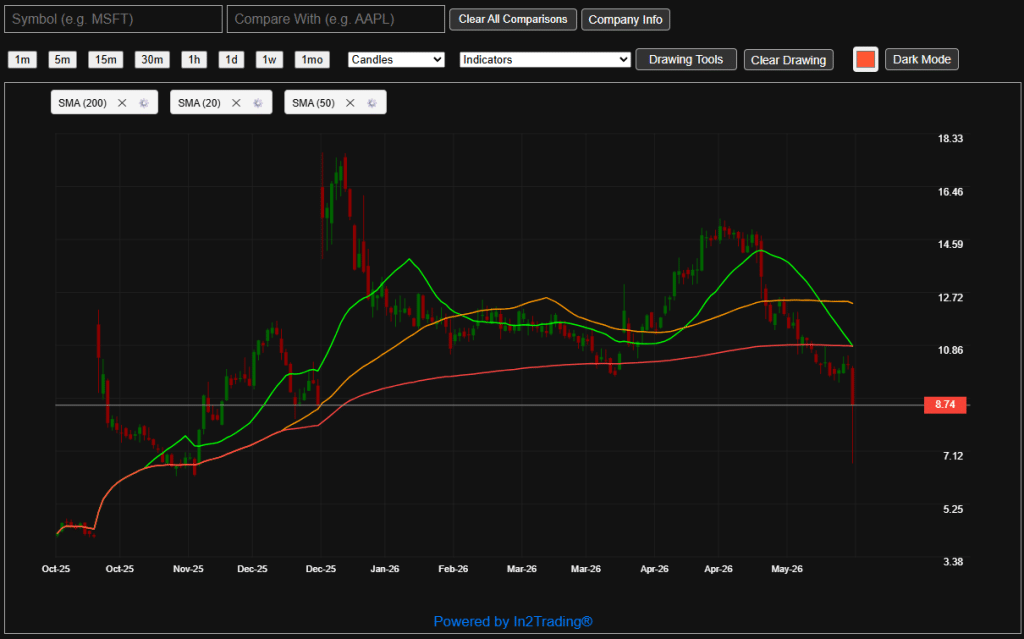
This wasn’t a gentle pullback. It was structural damage to the entire technical picture in a single session. OMER daily chart — price broken below all key moving averages. Source: In2Trading.
What the OMER Flash Crash Teaches Us About Flash Crashes
The OMER flash crash is a reminder that in the market, the worst risks aren’t the ones that unfold slowly — they’re the ones that happen in minutes. It happens when a wave of selling overwhelms the available buyers. Stop-loss orders trigger, which adds more selling, which triggers more stops — a feedback loop that can vaporize 20%, 30%, or more of a stock’s value before buyers step back in.
The key thing to understand is speed. In a normal decline, you have time to react. In a flash crash, the price can teleport through multiple levels before you’ve even refreshed your screen. OMER fell more than $3 per share in the opening minutes. Anyone with a stop loss in that zone got filled — and in fast markets like this, fills can slip well below the trigger price because the order executes at the next available price, not the price you set.
The Bigger Danger: Binary Event Risk
Flash crashes are scary, but there’s a related risk that’s even more dangerous for investors in certain stocks — especially clinical-stage biotechs like Omeros: the binary event.
A binary event is a moment where a stock’s fate hinges on a single yes-or-no outcome. For a biotech, that’s usually an FDA decision or a clinical trial readout. The drug works, or it doesn’t. The approval comes, or it doesn’t. There’s very little middle ground — and the stock reaction is correspondingly violent.
Here’s what makes binary events so dangerous: no stop loss can protect you. When a trial fails or an FDA rejection hits after hours, the stock doesn’t slide down through your stop — it gaps down. It can open 50% or more below the previous close, teleporting straight past your stop level. Your order fills at the new, much lower price. The protection you thought you had simply isn’t there.
While OMER’s specific catalyst wasn’t confirmed in the available data, the combination of extreme volume and a violent single-candle collapse is exactly what a negative company-specific event looks like — the kind of clinical or regulatory setback that defines binary event risk.
The Lessons for Every Investor
The OMER crash is a textbook case study. A few takeaways worth internalizing:
Position sizing matters most in volatile names. A stock that can lose a third of its value in 15 minutes is a stock where your position size — not your stop loss — is your real risk control. Never put in more than you can afford to see gap down.
Stops are protection, not a guarantee. A stop-loss order helps in orderly declines. In a flash crash or a gap-down, it can fill far below where you set it. Understand the difference before you rely on one.
Oversold is not the same as cheap. RSI at 24 will tempt bargain hunters, but in a news-driven crash, oversold conditions can stay oversold — or get worse. As Ask The Desk’s analysis noted, oversold alone is not a buy signal in a news-driven crash.
Know what you own. If you’re holding a clinical-stage biotech, you are exposed to binary event risk whether you realize it or not. That’s not a reason to avoid them — it’s a reason to size accordingly and never be surprised.
What to Watch on OMER from Here
- Key support: the $6.70 intraday low — a break below it on follow-through selling opens up more downside
- Resistance: the $10.00–$10.18 area (prior close and session open) — recapturing it would signal a real recovery
- The catalyst: watch for confirmation of what actually drove the move; the price action says something material happened
The OMER flash crash is a reminder that in the market, the most important risks aren’t the ones that unfold slowly — they’re the ones that happen in minutes, while you’re watching, with nothing you can do to stop them. The investors who survive them are the ones who planned for them before they happened. Flash crashes have been studied by regulators since the famous 2010 flash crash that briefly wiped nearly $1 trillion from US markets.
Want to run your own analysis on OMER or any other stock? Try Ask The Desk at desk.in2trading.com — AI-powered financial analysis built for investors.
This article is for informational purposes only and does not constitute financial advice. Always do your own research before making investment decisions.