A Transformation Already Underway
The AI financial industry transformation is already underway — and it’s moving faster than most investors realize. Over the past several years, AI has quietly moved from a buzzword on conference slides to a core part of how markets operate, how risk is assessed, and how investment decisions are made. The question is no longer whether AI will change finance. It’s whether you’re positioned to benefit from it.
Recent research from Cambridge University found that 81% of financial services firms are now adopting AI at some level — a figure that would have been unthinkable just five years ago. The transformation is no longer on the horizon. It is already reshaping every corner of the industry.
How the AI Financial Industry Operates Today
The world’s largest financial institutions have been investing in AI for over a decade. Here’s where it’s already making the biggest impact:
- Algorithmic trading: AI-driven systems now account for a significant portion of daily trading volume, executing strategies at speeds no human trader can match
- Risk management: Machine learning models analyze thousands of variables simultaneously to flag portfolio risk in real time
- Fraud detection: Banks use AI to monitor millions of transactions per second, identifying anomalies human analysts would miss
- Credit scoring: AI models are replacing traditional scores with more nuanced assessments that factor in behavioral data
- Research and analysis: AI tools are automating earnings reports, regulatory filings, and news monitoring — delivering summaries in seconds
What these use cases share is a common thread: AI is doing in milliseconds what previously took analysts hours, days, or entire teams. The competitive advantage it creates at the institutional level is enormous. And for a long time, that advantage stayed firmly behind closed doors.
The Retail Investor’s Moment
The democratization of the AI financial industry is happening right now. For most of financial history, the tools institutions used stayed on institutional desks. That is changing fast. The same AI capabilities that power hedge fund research and bank risk systems are now being built into accessible platforms designed for individual investors. The gap between what a retail investor can know and what a professional can know is narrowing at an unprecedented pace.
The democratization of financial intelligence is not a future event — it is happening right now. Platforms like Ask The Desk are part of this shift, bringing automated, data-driven research directly to investors who previously had no access to it. The AI financial industry rewards those who adapt early.
Ask The Desk in Action: Is TSLA Overvalued?
To understand what this shift looks like in practice, consider a question any investor might ask: Is Tesla overvalued?
A traditional research process would mean pulling SEC filings, cross-referencing P/E ratios against sector peers, digging through earnings transcripts, and piecing together a valuation picture from a dozen different sources. That process takes hours — if you know where to look. Most retail investors simply don’t have the time, the tools, or the data access to do it properly.
With Ask The Desk, the same question takes seconds. Type the ticker, ask the question, and the platform instantly pulls live financial data and delivers a structured analysis covering earnings-based valuation, revenue and margin trends, free cash flow, technical context, and both the bull and bear case — all in one response.
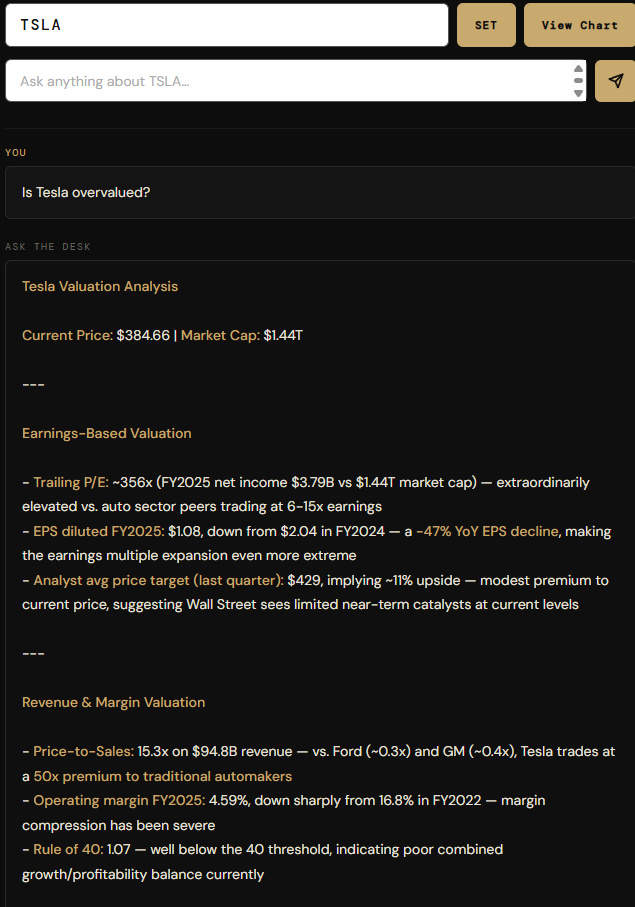
The response doesn’t stop at surface-level metrics. It goes deeper — free cash flow valuation at 233x, technical sentiment indicators showing bearish momentum, and a balanced breakdown of why the bears and bulls each have a legitimate case. The kind of nuance that separates informed decisions from guesswork.
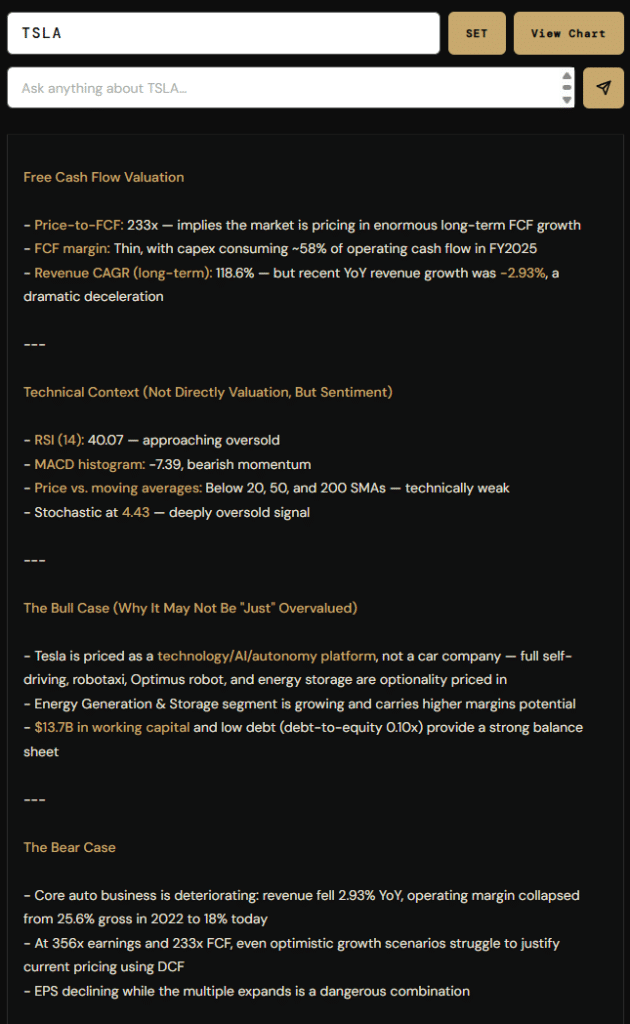
This is the kind of multi-layered analysis that previously required either a Bloomberg terminal, a professional analyst, or hours of independent research. Ask The Desk delivers it to any investor, on any plan, in under a minute.
For the full Tesla valuation and to run your own questions, visit desk.in2trading.com.
What This Means for How You Invest
The investors who will thrive in this new environment are not necessarily those with the most capital or the most experience. They are the ones who learn to use AI tools effectively — asking better questions, acting on cleaner data, and spending less time on research that a machine can do faster and more accurately.
AI doesn’t replace judgment. It enhances it. The best investment decisions will still come from humans — but those humans will be armed with better information than has ever been available before. The information advantage that once belonged exclusively to institutions is being democratized, one question at a time.
Success in the AI financial industry won’t come from having the most capital — it’ll come from using the right tools.
Ready to experience it? Visit desk.in2trading.com and ask your first question today.
This article is for informational purposes only and does not constitute financial advice. Always do your own research before making investment decisions.